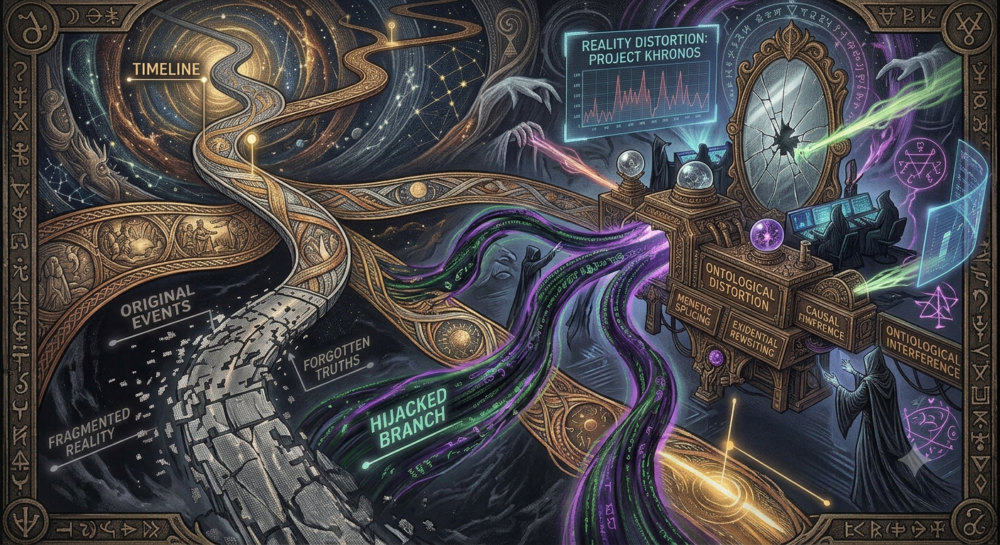
Mandela Effects first captured the public consciousness starting in 2009 when Fiona Broome coined the term after remembering Nelson Mandela dying in prison in the 1980s only to find out that he was still alive in 2009 and didn’t officially die until 2013. What makes Mandela Effects so compelling is that a large number of people from Generation X and older Millennials started reporting similar memories that didn’t match with the current history.
Most Gen-Xers remember this family of cartoon bears exactly as that, The Berenstein Bears. However, the official history records them as The Berenstain Bears.
Could this simply be a collective false memory? Unlikely. I say unlikely for a very good reason: the probability of nearly an entire generation having the exact same false memory is extremely low. However, “science” doesn’t have an explanation for history literally changing other than to claim these are false memories or claim that human memory is extremely fragile.
Is Human Memory Really Fragile?
Prior to the 2010s, human memory was considered generally trustworthy and formed the baseline for both jurisprudence and cognitive science. For centuries, legal frameworks operated on the premise that eyewitnesses reliably recall major events, even if minor specifics fade over time. Classical cognitive psychology similarly framed memory as an information-processing system designed to extract real signals from environmental noise, using logical shortcuts to fill gaps rather than inventing false realities.
Laboratory studies that popularize memory’s “fragility” almost exclusively manipulate peripheral details, like whether a vehicle passed a stop sign or a yield sign, while leaving the central facts untouched. In real-world situations, people consistently remember the core event; a crash occurred, these people were involved, and this was the outcome, with high fidelity. In unmanipulated, everyday environments, the human brain efficiently retains the essential meaning and structure of experiences while discarding irrelevant background noise, operating precisely as a dependable system should.
The literal name of bear family in the books we Gen-Xers grew up with is not irrelevant background noise. It is the core part of that memory. The price of the book in K-Mart or whether it was bought at K-Mart or Sears would be irrelevant background noise. However, “scientists” and “skeptics” often gaslight the public by claiming that core parts of a memory are easily forgotten and point to studies that show only the irrelevant background noise elements are easily forgotten.
So, What’s Really Going On?
If human memory is not fragile on core details and so many people remember core details that are at odds with the official history then something must be going on here that is not easy to explain. I have a theory that could provide a possible explanation.
Timelines are real, but they aren’t what science tells you they are
The Many Worlds Interpretation of Quantum Mechanics is an interpretation of Quantum Mechanics that posits the idea that there are an infinite number of identical “universes” stacked on top of each other. Some interpretations, like Quantum Immortality, suggest that when you die, you simply slip into another identical universe.
To me, this sounds like the atheist version of the, very real, Western Mediterranean reincarnation cycle. This tradition, found in places like Sicily and Iberia, draws on Greek Chthonic deities like Hecate and Persephone along with Egyptian ideas found in the Book of the Dead.
I live again and again after death like Ra, day by day.
– Utterances of Coming Forth by Day
In this tradition, life is an endless cycle; born -> live -> die -> born. However, the new birth takes place, not at some future date in a linear timeline, but rather on the same day and same year each time – born in 1969 this time means born in 1969 every time.
Another element of this tradition is that the mobile part of the soul (Ba in Egyptian or Eidolon in Greek) is susceptible during sleep. A hostile agent could trap the Ba/Eidolon in a dream realm for an extended period of time, consider Odysseus in the Odyssey.
Types of Mandela Effects
There are, with my counting, three types of Mandela Effects. The first is brand or pop culture modifications. The second is people being alive who many remember already dying. The third are major historical differences.
As we move from the first to the third fewer and fewer people experience them. For example, most people experiencing Mandela Effects will remember Jiffy rather than Jif or “Luke, I am your father” rather than “No, I am your father.” However, fewer people remember Pope Francis dying twice in the same year and even fewer people remember a completely different history of the 1970s.
By looking at these categories of Mandela Effects, I was led to a theory that combines C.E.R.N type theories of timeline manipulation with the Mediterranean idea of the susceptibility of the Ba/Eidolon during sleep.
Timeline Manipulation is Happening, But It’s Not What You Think
Consider the possibility that hostile agents in one or more base timelines believe they are running psychological experiments on Gen-Xers and Millennials during sleep cycles. I know this sounds far-fetched, but hear me out then make your own decision.
One of the historical difference Mandela Effects that some older Gen-Xers experience is how the scientific rationalism movement of the 1970s fizzled out and the general apathy towards Cosmos in 1980 was the final nail in the coffin of the skeptical movement. However, in this timeline, Cosmos kicked off the inevitable victory of the skeptical movement. If the Gen-Xers who share this memory are correct, then is it really far-fetched to imagine this same community might figure out how to manipulate dreams? In fact, this exact thing has been considered as a cheaper way to punish prisoners: insert 1000 years of incarceration memories into the prisoner in about 8 hours.
If you wanted to change the course of history because you lost the culture war and you could insert 40-50 years of memories of an atheistic and scientific technocracy into teen and young adult minds during a couple nights of sleep, would you do it?
The basic theory, as I have it at the moment works like this:
Category One
These are people who only have basic brand or pop culture Mandela Effects. This is likely the first dream cycle they have been trapped in. These are basic memories from their base timeline.
Category Two
These are people who have both brand or pop culture Mandela Effects and dead people still being alive or dying a second time. This is likely the second dream cycle they have been trapped in. The brand and pop culture Mandela Effects are memories from their base timeline while the other Mandela Effects are from the previous dream cycle trap.
Category Three
These people have all the same Mandela Effects as Category Two, but they also have wildly different history Mandela Effects. These are people who may be in their third dream cycle “hijacking” and are starting to understand what is happening. The wildly different history elements are from their base timeline and they have woken up and lived days, weeks, or months in their base timeline between sleep cycle hijackings.
Wrap-Up – For Now
I can’t prove any of these things, nor am I 100% sure they are correct. However, I put them out into the world as a possible solution, or beginning of a solution to Mandela Effects that don’t rely on too out there theories.
Notes
Schema Theory & Reconstructive Gap-Filling: Sir Frederic Bartlett established that memory uses existing knowledge structures (“schemas”) to fill missing gaps logically during reconstruction, preserving essential meaning rather than inventing false facts out of nowhere (Bartlett, 1932).
Information-Processing Architecture: Richard Atkinson and Richard Shiffrin formulated the Multi-Store Model, establishing the classical paradigm of human memory as an organized information-processing system designed to filter, encode, and retrieve environmental signals (Atkinson & Shiffrin, 1968).
Synthesis & Cognitive Shortcuts: Ulric Neisser synthesized these early cognitive paradigms, describing human memory as an active “analysis-by-synthesis” process that uses cognitive heuristics to extract real environmental signals and accurately reconstruct past events (Neisser, 1967).
The Rationalist Tradition of Judicial Evidence: Jeremy Bentham established the foundational “rationalist tradition” of Anglo-American evidence law, arguing that human testimonial memory operates on common-sense inferential reasoning (Bentham, 1827). Bentham argued that courts should assume witnesses generally tell the truth about core facts, with cross-examination serving to weed out minor errors or deceit rather than assuming memory is inherently untrustworthy.
The Standard Legal Treatise on Eyewitnesses: John Henry Wigmore produced the definitive legal treatise on Anglo-American evidence law, establishing the legal presumption that human memory accurately captures core facts (“circumstantial probability of trustworthiness”) unless specific corrupting factors—like bias or coercion—are present (Wigmore, 1904).
Legal Realism and Eyewitness Evaluation: John William Salmond codified the common-law distinction between core narrative accuracy and minor detail degradation, establishing that minor inconsistencies in eyewitness recall do not invalidate the overall integrity of the witness’s core testimony (Salmond, 1907).
References
Atkinson, R. C., & Shiffrin, R. M. (1968). Human memory: A proposed system and its control processes. In K. W. Spence & J. T. Spence (Eds.), The psychology of learning and motivation: Advances in research and theory (Vol. 2, pp. 89–195). Academic Press. https://doi.org/10.1016/S0079-7421(08)60422-3
Bartlett, F. C. (1932). Remembering: An experimental and social study. Cambridge University Press.
Bentham, J. (1827). Rationale of judicial evidence, specially applied to English practice (J. S. Mill, Ed.; Vols. 1–5). Hunt & Clarke.
Neisser, U. (1967). Cognitive psychology. Appleton-Century-Crofts.
Salmond, J. W. (1907). Jurisprudence: Or, the theory of the law (2nd ed.). Stevens and Haynes.
Wigmore, J. H. (1904). A treatise on the system of evidence in trials at common law: Including the statutes and judicial decisions of all jurisdictions of the United States (Vols. 1–4). Little, Brown and Company.