How We Lost a Real Mystery to Sensationalism, Skepticism, and Our Fear of Not Knowing
The Bermuda Triangle once captivated imaginations around the world—a mysterious stretch of the Atlantic Ocean bordered by Miami, Bermuda, and Puerto Rico, where ships and planes vanished without a trace. For decades, the legend dominated books, news reports, and dinner table conversations. Then, overnight, the mystery itself vanished from public consciousness. Not because the disappearances stopped, but because the quest for answers was quietly sabotaged—sometimes by the very people drawn to the enigma.
Debunking, myth busting, and related ideas are atheistic attempts to drain the wonder and mystery from the world. A world without mystery quickly becomes a nihilistic wasteland. Maybe, that was the point all along. The Bermuda Triangle and related mysteries represent a deep seeded human need rooted in ancient, polytheistic, cosmology that is at odds with the sterile world of “trust the science.”
The Peak Years
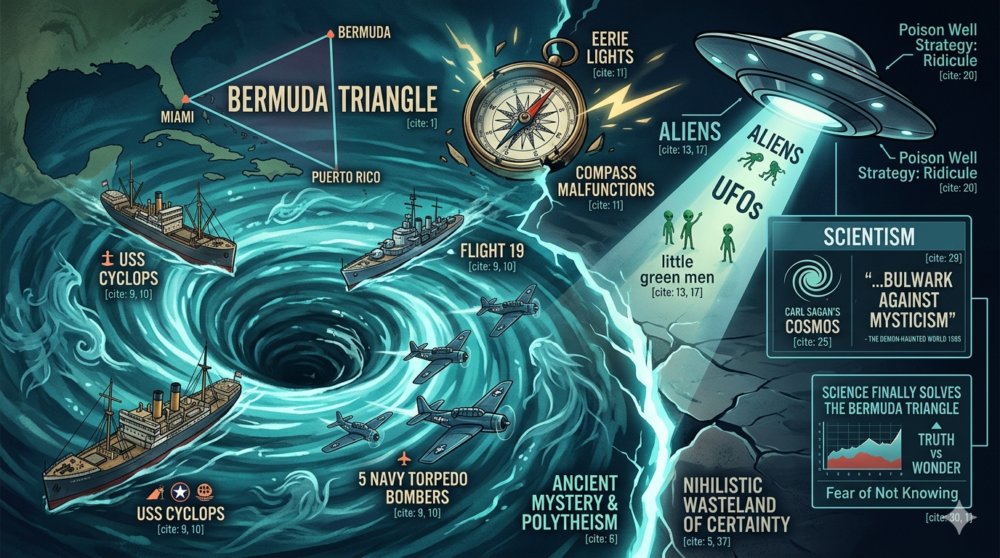
In the early 1960s through the 1970s, the Bermuda Triangle was everywhere. Vincent Gaddis gave the area its now-famous name, and Charles Berlitz’s bestselling book sold more than 20 million copies worldwide. The legend grew with each retelling of cases like Flight 19—a squadron of five Navy torpedo bombers and their fourteen crew, lost without a trace during a training mission—and the USS Cyclops, which disappeared with 309 men aboard, never sending a distress call. The freighter Marine Sulphur Queen joined the list, vanishing with all hands. Pilots and sailors reported compass malfunctions, eerie lights, and seas that seemed to swallow vessels without warning. The U.S. Coast Guard issued no official explanation. For a brief, electric stretch of time, mainstream culture accepted that some places on earth still defied explanation. Then, the narrative took a turn.
Aliens — The Poison Well Strategy
No flying saucers abducted Flight 19, and no portal opened beneath the Atlantic. Yet in the 1970s, sensationalist authors and television specials pushed the extraterrestrial angle—because it sold. When aliens became linked to the Bermuda Triangle, the entire mystery became a joke. Skeptics no longer needed to address the actual disappearances; they just had to ask, “Do you believe in little green men?”
UFOs and aliens come from the same place; atheistic materialism. Technology based theories allow the “skeptics” to do exactly what Mark Twain warned against, they drag you down to their level then beat you with experience. Technology based theories serve to demystify the world and change the narrative from balancing gods, land spirits, etc. as our ancient ancestors would have done to one where the nerds (albeit intergalactic nerds) are the supreme beings.
The poison well strategy succeeded: introduce one absurd explanation, let the media amplify it, and watch as the whole field collapses into ridicule. The alien narrative wasn’t an innocent mistake. It was sabotage masquerading as honest speculation.
The Rise of Scientism
“Science is a way to call the bluff of those who only pretend to knowledge. It is a bulwark against mysticism, against superstition, against religion misapplied to where it has no business being.”
— Carl Sagan, The Demon-Haunted World 1995
Though he wouldn’t make the claim above until fifteen years after the premier of Cosmos on September 28, 1980, that very sentiment underpinned everything Cosmos stood for. It was literally a new mythology for the nihilistic atheist. Cosmos proposed to strip the wonder of life and replace it with a cold and sterile “cosmic accident.”
I remember seeing part of one episode (One Voice in the Cosmic Fugue) where Sagan and another scientist zapped mud with electricity. As my dad was flipping through the channels and landed on WPBT (Channel 2) I remember my blue collar dad’s reaction clearly; “This is what happens when stupid people get a few letters behind their name.” The blue collar disrespect of scientism was just as real as the arrogant ideas being presented as learned and high-brow on PBS.
On the heels of Sagan and the rise of pop Science, magazines ran headlines like “Science Finally Solves the Bermuda Triangle,” even when the evidence was thin or inconclusive. Researchers stopped paying attention to the true anomalies. Basically, scientism shifted the rules, so the question no longer mattered.
The Loss of Wonder and Mystery
And so, the Bermuda Triangle faded from public imagination—not because it became safer, but because we lost permission to say, “I don’t know.” We lost permission to speculate on upset sea spirits. We lost a big part of our humanity. Airliners still cross those coordinates, and ships still ply the Sargasso Sea, but our culture, addicted to quick and final answers, can no longer tolerate genuine mystery. The Triangle still harbors unexplained disappearances, their files gathering dust in Coast Guard archives, their stories kept alive only by families who never received closure. But few ask questions anymore.
The Triangle is still there. The sea sprits are still there. We simply walked away—not because the mystery died, but because, in our relentless quest for certainty, a part of us did.